Best Gym Exercises For Building Muscle Mass
Discover the most effective exercises for muscle hypertrophy with proven techniques and real results in 8-12 weeks.
Ever trained for months without seeing serious gains? The problem isn't lack of effort: 78% of people at the gym are doing the wrong exercises for their goals.
Here's the truth: building muscle takes strategy. It's not enough to just "lift heavy" - you need the right exercises, performed correctly, with appropriate load. And way too many people waste months (sometimes years) focusing on movements that generate minimal growth stimulus.
In this ultimate guide, you'll discover the 10 most effective exercises for muscle hypertrophy, backed by science and tested by thousands of lifters. You'll also learn proper technique, mistakes that stall your progress, and how to build a program that actually works.




Summary
- Why Exercise Selection Defines Your Results
- Compound vs Isolation Exercises: Understanding The Difference
- Barbell Back Squat: The King of Hypertrophy
- Deadlift: Total Mass Builder
- Bench Press: Foundation For Bigger Pecs
- Bent-Over Row: Wide, Thick Back
- Overhead Press: Shoulder Development
- Pull-Ups: Real Strength Test and Builder
- How To Structure Your Hypertrophy Training
- Mistakes That Kill Muscle Growth
- Frequently Asked Questions
- Conclusion
Why Exercise Selection Defines Your Results
The difference between gaining 10 lbs of muscle or 2 lbs in a year is directly tied to the exercises you choose. It's not about training more - it's about training smarter.
Exercise physiology research shows that compound lifts stimulate the release of hormones like testosterone and growth hormone, which aid in muscle growth. This creates an ideal metabolic environment for hypertrophy.
Why Compound Exercises Are Your Priority
If you could only choose 5 exercises for the rest of your life, they should all be compound movements. They work large muscle chains, save time, and generate systemic adaptations that accelerate all your progress.
A study published in Frontiers found that multi joint exercises had a greater effect on cardiovascular fitness and VO2 max compared to isolation exercises. For those starting out or with limited time, focusing on efficient compound movements can mean saving 30-40 minutes per workout while maintaining the same results.
If you're serious about gaining muscle mass, understanding exercise selection is fundamental. When you pair smart training with proper nutrition for muscle growth, results accelerate significantly.
Compound vs Isolation Exercises: Understanding The Difference
Before diving into the best exercises, you need to understand this fundamental division that defines every smart training strategy.
Compound (Multi-Joint) Exercises
Compound exercises involve movement at two or more joints and recruit multiple muscle groups simultaneously. They're the foundation of any serious hypertrophy program.
Classic examples: Squats, deadlifts, bench press, rows, overhead press, pull-ups.
Why they work better:
- Allow use of significantly heavier loads (greater mechanical tension)
- Stimulate more intense anabolic hormone production
- Generate greater metabolic stress and systemic adaptation
- Develop functional strength that transcends the gym
- Optimize time: one exercise works 3-5 muscle groups
A barbell squat targets the quads, glutes, and hamstrings while ensuring your knees stay soft and aligned with your hips. A well-executed squat activates over 200 muscles. You can work thighs, glutes, core, lower back, and even calves in a single movement. That's maximum efficiency.
Isolation (Single-Joint) Exercises
Isolation exercises focus on one muscle or specific group, moving only one joint. They have an important role, but as a complement.
Examples: Bicep curls, tricep extensions, lateral raises (shoulders), leg curls (hamstrings).
When they're essential:
- Correcting muscular imbalances (one side weaker than the other)
- Adding extra emphasis to small muscles that don't get enough stimulus from compounds
- Working specific muscles during injury rehab
- Adding training volume without overloading the central nervous system
Criteria | Compound Exercises | Isolation Exercises |
|---|---|---|
Muscles Activated | 3-6 groups | 1-2 groups |
Load Used | High (220-440+ lbs) | Low to Medium (10-65 lbs) |
Hormonal Release | High (testosterone, GH) | Moderate |
Caloric Burn | High (15-20 cal/min) | Low (8-12 cal/min) |
Technical Complexity | High | Low |
Training Priority | 1st (70% of workout) | 2nd (30% of workout) |
The Ideal Proportion In Your Training
To maximize hypertrophy, the recommended distribution is:
- 70% compound exercises: 2-3 compound exercises per workout, performed at the start when you have the most energy
- 30% isolation exercises: 1-3 isolation exercises per workout, used at the end to complement
This ratio ensures you get the best of both worlds: significant mass gains from compounds, fine-tuning and symmetry from isolations.
For a deeper dive into building balanced programs, check out our comprehensive muscle hypertrophy guide.

Barbell Back Squat: The King of Hypertrophy
If there's one exercise you NEED to master for building muscle, it's the barbell back squat. It's no exaggeration to call it the "king of exercises."

The squat works practically your entire body. When you descend with a bar on your back, you're activating quads, glutes, hamstrings, calves, entire core, spinal erectors, and even shoulder stabilizers.
Proper Technique For Maximum Results
Perfect execution makes all the difference between explosive gains and injury risk:
Starting position: Bar resting on upper traps (not on your neck). Grip slightly wider than shoulders. Feet hip-width apart, slightly turned out (15-30 degrees).
Eccentric phase (descent): Take a deep breath and brace your core. Start the movement by pushing your hips back, like sitting in a chair. Keep chest up and spine neutral. Descend until thighs are parallel to the floor (or below if your mobility allows).
Concentric phase (ascent): Drive through the floor with your feet, keeping weight mid-foot. Explode upward, exhaling at the top. Avoid completely locking out your knees at the top.
Critical attention points:
- Knees should track in line with toes (they can't cave inward)
- Spine stays neutral the entire time - don't round your lower back
- Eyes fixed forward, never looking down
- Core always braced like you're about to take a punch
For quality training equipment that supports proper form, consider investing in adjustable dumbbells or a home workout bench to complement your gym routine.
Progression and Variations
For beginners: Start with just the barbell (45 lbs) focusing 100% on perfect technique. Do 3-4 sets of 10-12 reps. Only add weight when technique is flawless.
For intermediates: After 2-3 months, you should be able to squat your bodyweight. Work in the range of 3-5 sets of 6-10 reps, increasing 5-10 lbs per week when you complete all reps with good form.
Effective variations:
- Front squat (bar in front): Greater quad emphasis
- Sumo squat (feet wide apart): Works more glutes and inner thighs
- Bulgarian split squat (single leg): Corrects imbalances
Ideal for: Anyone seeking significant muscle mass gain. Especially effective for developing legs and glutes, but with systemic benefit for the entire body.
Squats are foundational to any serious muscle building program. When combined with proper protein intake, they become even more powerful for growth.

Deadlift: Total Mass Builder
The deadlift is probably the most complete exercise that exists. It literally works your entire body in one explosive movement.

The Deadlift is one of those full-body moves that hits the posterior chain, especially the hamstrings, glutes, and lower back. When you pull a heavy bar off the ground, you're recruiting: the entire posterior chain (glutes, hamstrings, spinal erectors), traps, lats, forearms, core, and even quads. It's almost impossible to find a muscle that DOESN'T work.
Why It's So Effective For Hypertrophy
The deadlift allows the heaviest loads of any exercise. It's not uncommon to see intermediate lifters pulling 265-400 lbs. This extreme mechanical stress forces your body to adapt, producing a massive anabolic hormonal response.
Plus, the movement mimics real functional patterns (picking up something heavy from the floor), which makes your body very efficient at recruiting muscle for the task.
Safe Technical Execution
The deadlift demands respect for technique. Executed correctly, it's one of the safest exercises. Done carelessly, it can be problematic.
Initial setup:
- Bar over mid-foot (laces of your sneakers)
- Feet hip-width apart
- Grip the bar at shoulder width
- Shoulders slightly in front of the bar
- Neutral spine (neither arched nor rounded)
- Core 100% braced
Execution:
- Pull the slack out of the bar (tension it before it leaves the floor)
- Drive through the floor with your feet simultaneously
- Keep bar close to your legs during the entire ascent
- Finish with hips extended and shoulders back
- Lower with control along the same path
Fatal mistake you MUST avoid: Rounding your lower back. This transfers all stress to spinal discs instead of muscles. If your form breaks down, reduce the weight immediately.
Important Variations
Conventional deadlift: Standard version, best for most people. Works the entire posterior chain most completely.
Sumo deadlift: Feet wide apart, greater emphasis on glutes and adductors. Great for people with long leg proportions.
Romanian deadlift: Starts from standing (not from floor), total focus on hamstrings and glutes. Excellent accessory exercise.
To learn more about structuring complete training programs, check out our complete muscle gain guide. Supporting your deadlifts with quality supplements can also enhance recovery and growth.
Bench Press: Foundation For Bigger Pecs
The bench press is the fundamental exercise for chest development. It's the movement that best allows progressive overload for this region, essential for building volume.
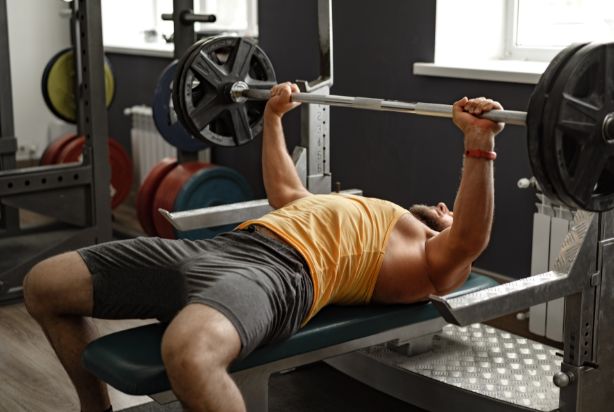
Besides the pectoralis major (which does most of the work), the bench press heavily recruits triceps, anterior deltoids, and various trunk and shoulder stabilizer muscles.
The Technique That Maximizes Chest Activation
Lots of people bench press wrong and end up turning the exercise into a shoulder and tricep workout. Small technical adjustments completely change where you feel it working.
Position on bench:
- Eyes aligned with bar when it's in the rack
- Shoulder blades retracted and depressed (pinched together and pulled down)
- Natural arch in lower back, but glutes glued to bench
- Feet firmly on floor, pushing to create stability
Grip and movement:
- Grip slightly wider than shoulder width
- Lower bar with control until it touches at nipple line
- Elbows at 45-60 degree angle (not 90 degrees flared out)
- Press bar up and slightly back (diagonal trajectory)
Breathing: Inhale on descent, hold air at the hardest point, exhale in the final third of ascent. This creates intra-abdominal pressure that protects your spine.
Smart Progression
Phase 1 (weeks 1-4): Master technique with submaximal loads. If you can do 10 reps, use weight that allows 8. Focus on feeling the chest work.
Phase 2 (weeks 5-12): Apply progressive overload. Try to add 2-5 lbs per week or 1 extra rep when you complete all sets.
Phase 3 (months 4+): Vary stimuli. Alternate between 5-8 rep ranges (strength) and 8-12 reps (hypertrophy). Include incline bench and dumbbell variations.
Complementary Variations
Incline bench press (30-45 degrees): Emphasizes upper chest (clavicular portion). Essential for complete and proportional chest.
Dumbbell bench press: Allows greater range of motion and works each side independently, correcting imbalances.
Close-grip bench press: Narrower grip transfers emphasis to triceps, but still works chest well.
Ideal for: Development of the entire chest-shoulders-triceps complex. Combined with back exercises, creates a balanced and athletic torso.
Quality whey protein post-workout can significantly enhance muscle protein synthesis after heavy pressing sessions.
Bent-Over Row: Wide, Thick Back
Big backs don't come from machines - they come from heavy rows. The bent-over barbell row is the fundamental compound exercise for developing back density and thickness.

This movement works practically all back muscles: latissimus dorsi, middle and lower traps, rhomboids, teres major, plus recruiting spinal erectors, core, and even hamstrings isometrically.
Technique For Maximum Back Activation
The bent-over row is technically demanding. The hinged position adds significant challenge to spinal erectors and core.
Correct positioning:
- Grab bar with overhand grip (palms down), shoulder-width
- Hinge torso about 45 degrees relative to the floor
- Knees slightly bent
- Spine neutral throughout the ENTIRE movement
- Bar starts at shin height or just below knees
Movement execution:
- Pull bar toward belly button/lower abdomen
- Drive elbows back, not out to the sides
- Squeeze shoulder blades together at the top
- Feel the back working, not just arms
- Lower with control to almost full arm extension
Devastating common mistake: Using hip momentum to swing the bar up. This removes all work from the back and turns the exercise into a poorly done deadlift.
How To Know If You're Doing It Right
If you feel mainly arms/biceps working, you're doing it wrong. The focus should be between the shoulder blades and in the lat region.
Simple test: Do a set with 60-70% of the weight you normally use, completely focused on contracting your back first, "pulling" with it instead of bending your elbows. Arms are just cables transmitting force.
Effective Variations
Underhand row: Same technique, but inverted grip (palms up). Activates more of the lower lats and allows slightly more weight.
Pendlay row: Bar starts and returns to floor each rep, with torso parallel to floor. More explosive version, excellent for strength.
Dumbbell row: Unilateral, allows greater range and corrects imbalances. Support one hand on bench and focus one side at a time.
Strong backs are essential not just aesthetically, but to balance all upper body development. To further balance training, check out our material on complete mass-gaining strategies.
Overhead Press: Shoulder Development
Broad, well-developed shoulders completely transform your physique. The barbell overhead press (military press) is the number one exercise for building big deltoids.
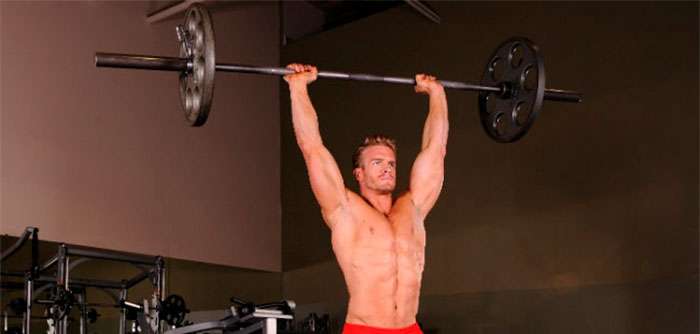
This movement primarily works all three heads of the deltoid (anterior, lateral, and posterior), with emphasis on anterior and lateral. As a bonus, it recruits upper traps, serratus anterior, triceps, and the entire core.
Why Overhead Press Beats Other Shoulder Exercises
Compared to lateral raises or machine presses, the barbell military press allows:
- Use of progressively heavier loads over months/years
- Activation of stabilizer muscles that contribute to stronger shoulders
- Natural movement pattern that transfers to daily activities
- Greater systemic hormonal stimulus from being a heavy compound exercise
Strength athletes, gymnasts, and fighters historically have impressive shoulders. What do they all have in common? Movements pressing load overhead.
Perfect Technical Execution
The overhead press can be done standing or seated. The standing version is more complete as it recruits more core and legs as stabilizers.
Initial setup:
- Bar at shoulder height in rack
- Grip slightly wider than shoulder width
- Position yourself with bar resting on upper chest
- Feet hip-width apart
- Core 100% braced, glutes activated
Movement:
- Press bar upward in vertical trajectory
- When bar passes face height, bring head slightly forward
- Finish with arms extended (not locked), bar aligned over head
- Lower with control along same path
- Bar returns to lightly touch upper chest
Crucial detail: Don't excessively arch your lower back to press the bar. If you need to do this, reduce the weight. Movement should be vertical, not diagonal.
Progression For Hypertrophy
To build big, strong shoulders with the overhead press, progression is simple and effective:
- Sets: 3 to 5
- Reps: 6 to 10
- Rest: 90 to 150 seconds
- Progression: increase 5 lbs when you hit the top of the rep range with good form
If you feel shoulder discomfort, alternate with dumbbells or do the seated version for a few training cycles.
Supporting shoulder training with quality creatine can enhance strength and power output during heavy presses.
Pull-Ups: Real Strength Test and Builder
The pull-up is one of the most honest exercises in strength training. Either you lift your own bodyweight, or you don't. There are no machines "helping" the movement.
It primarily develops:
- Latissimus dorsi (back width)
- Biceps
- Forearms
- Lower traps
- Core
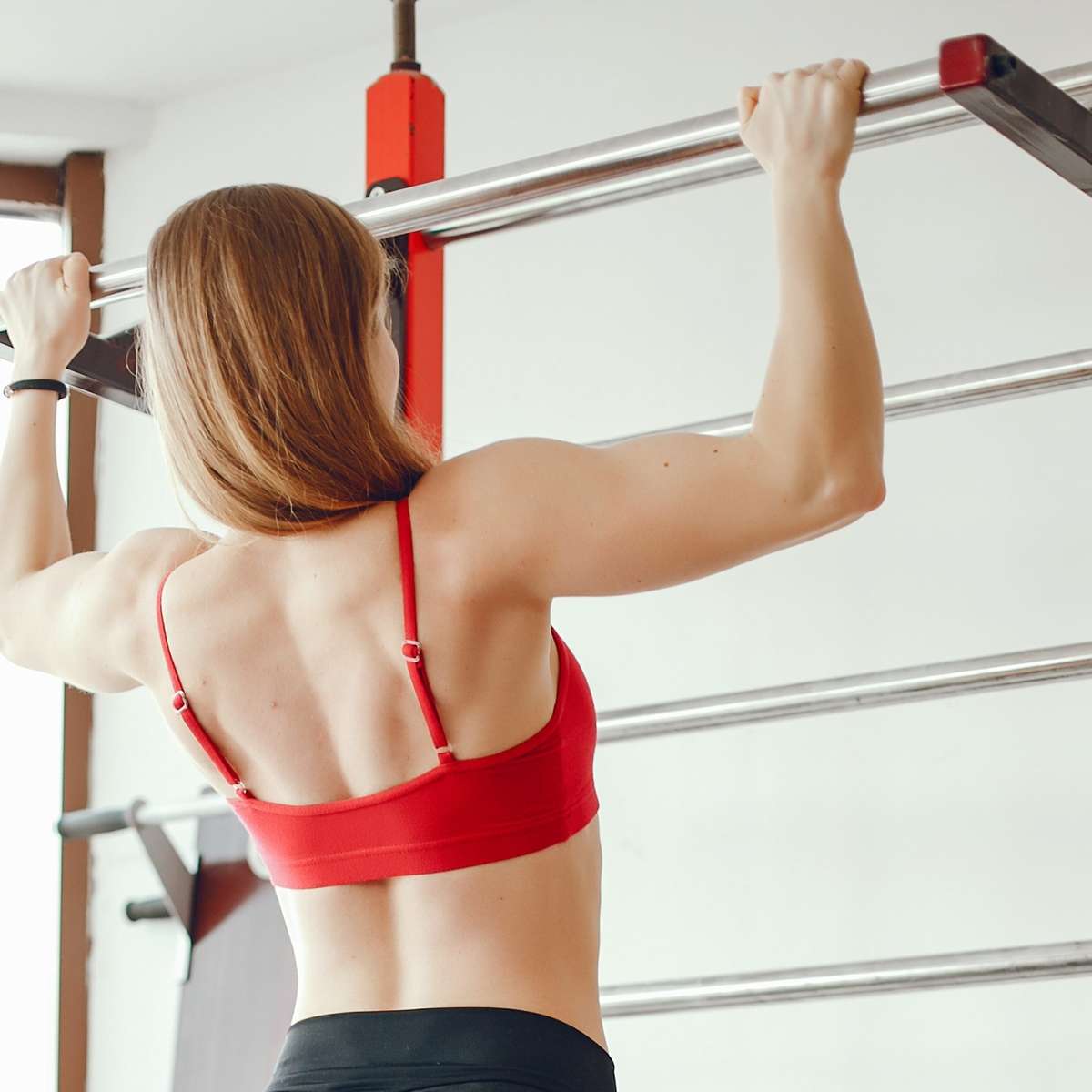
Why Pull-Ups Are Essential For Hypertrophy
- Builds wide backs in a "V" shape
- Develops relative strength (strength relative to bodyweight)
- Improves mind-muscle connection
- Serves as foundation for advanced progressions (weighted pull-ups)
Few exercises deliver so much muscle mass with such a simple movement.
Correct Execution
- Overhand grip (palms forward), slightly wider than shoulders
- Start hanging with relaxed shoulder blades
- First movement: retract shoulder blades
- Pull body until chin clears the bar
- Lower with control, don't just drop
Common mistake: using leg momentum. If you're swinging, the stimulus drops.
Can't Do Pull-Ups Yet? No Problem
You can progress with:
- Assisted pull-up machine
- Resistance bands
- Negatives (jump up with assistance and lower slowly)
With consistency, bodyweight pull-ups will come naturally.
To accelerate your pull-up progression and overall back development, ensure you're getting adequate protein intake and consider resistance band training as a complement.
How To Structure Your Hypertrophy Training
It doesn't matter if you choose the best exercises and build a terrible program. Structure makes all the difference.
Basic Principles
- Prioritize compound exercises
- Train each muscle 2x per week
- Use progressive overload
- Maintain adequate weekly volume
Example Simple Structure (Upper / Lower Split)
Workout A – Upper Body
- Bench press
- Bent-over row
- Overhead press
- Pull-ups
- Bicep curls
- Tricep extensions
Workout B – Lower Body
- Back squat
- Romanian deadlift
- Leg press
- Leg curls
- Standing calf raises
Training 4x per week alternating A/B already generates great results.
For those interested in home training alternatives, check out our guide on bodyweight workouts which can complement gym training effectively.
Mistakes That Kill Muscle Growth
Even training hard, many people don't grow because of these errors:
- Changing exercises every week without progression
- Training too heavy and failing every set
- Neglecting rest and sleep
- Eating fewer calories than you burn
- Performing exercises with poor technique
Hypertrophy is simple, but it's not chaos. Understanding calories and proper nutrition timing is crucial for muscle growth success.
Quality supplements can fill nutritional gaps. Consider diet books to optimize your nutrition strategy, or melatonin to improve sleep quality for better recovery.
Frequently Asked Questions
How many exercises per muscle should I do?
Between 2 and 4 exercises per week for each muscle is enough when there's intensity and progression.
Is training to failure mandatory?
No. Training close to failure already generates maximum stimulus with less injury risk and excessive fatigue.
Can I build muscle training 3x per week?
Yes. As long as there's volume, intensity, and adequate nutrition, 3 weekly workouts work very well.
Does cardio hurt muscle growth?
Not if done in moderation. Excessive cardio without caloric adjustment can interfere. Learn more about balancing cardio vs weight training.

Conclusion
Building muscle at the gym doesn't depend on fancy exercises, but on smart choices. Squats, deadlifts, bench press, rows, overhead press, and pull-ups form the foundation of real hypertrophy.
Build your training around these movements, progress loads with patience, sleep well, and eat enough. Solid results come from consistency - not shortcuts.
Remember: the best program is one you can stick to long-term. Whether you're following an upper/lower split, push/pull/legs, or full-body routine, what matters most is progressive overload on these core movements combined with proper recovery and nutrition.
If you're struggling with motivation or consistency, consider our guide on avoiding burnout and maintaining long-term mental health throughout your fitness journey.
Start with these fundamentals, track your progress, and give yourself at least 12 weeks of consistent training before evaluating results. Building muscle is a marathon, not a sprint - but with the right exercises and approach, you'll be amazed at what your body can achieve. What Makes an Exercise Effective For Muscle Gain
There are objective criteria that separate mediocre exercises from exceptional ones for hypertrophy:
Muscle activation: The more muscle fibers an exercise recruits, the greater the growth potential. Movements involving multiple joints (compound) naturally activate more musculature than single-joint movements (isolation).
Progressive overload: The best exercises allow you to gradually increase load for years. Progressive overload is one of the most important strength training principles and it's necessary if you want to gain strength or build muscle. You need to be able to consistently add weight to the bar to force muscular adaptation.
Range of motion: Exercises with greater range of motion work the muscle from stretch to full contraction. This generates more microtrauma (which then regenerates bigger) and greater time under tension.
Stability and safety: An exercise needs to allow proper technical execution even with heavy loads. Unstable movements limit how much weight you can use, reducing the stimulus.